
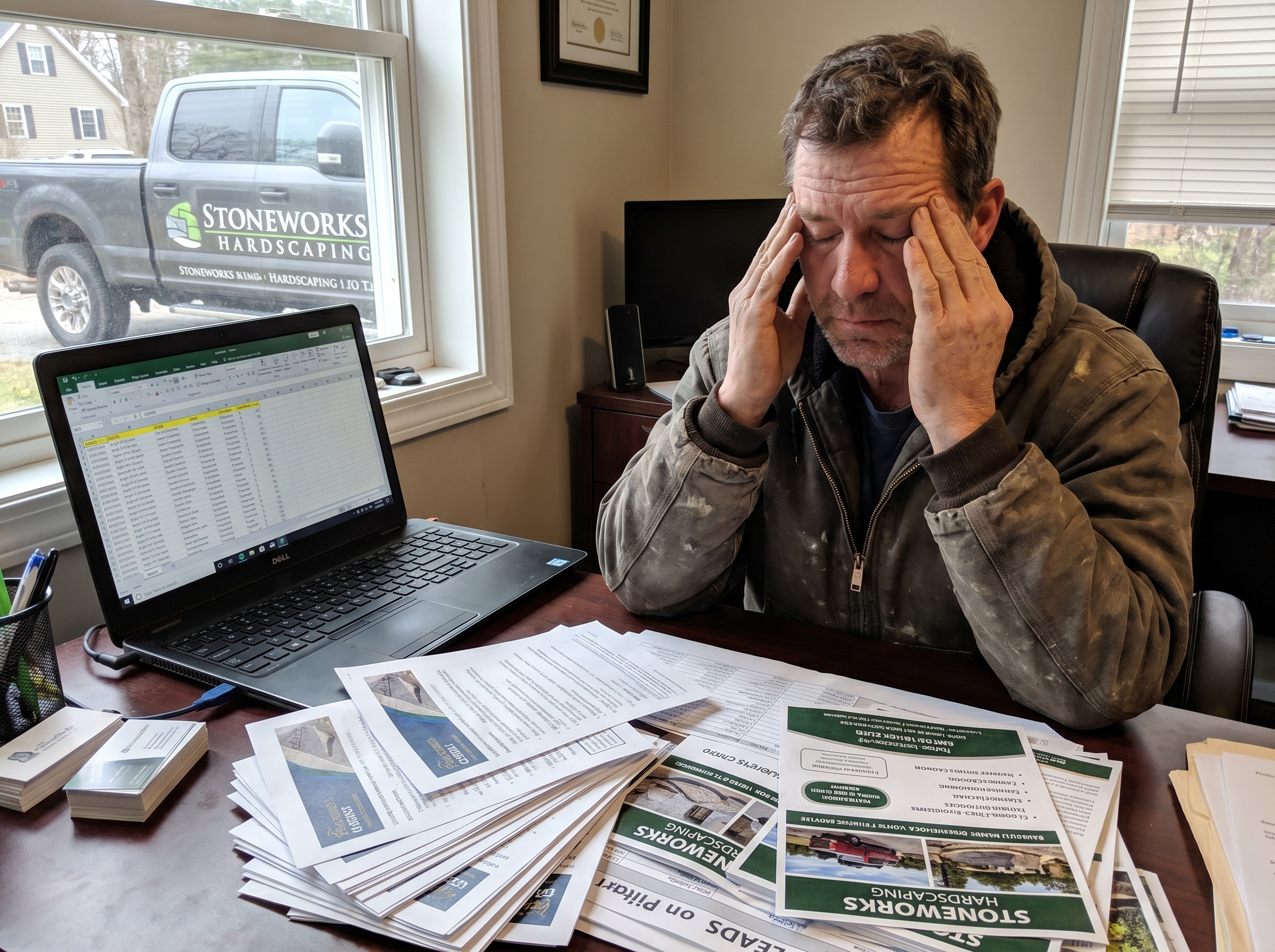
Mike runs a solid hardscape operation. Three crews, decent equipment, a reputation that took him ten years to build. Last spring, he hired a marketing agency that promised to “flood his pipeline.” They delivered. Eighty-three leads in April.
He made payroll by the skin of his teeth.
The problem wasn’t his crews. It wasn’t his pricing. It wasn’t even the agency, technically they did what they said they would do. The problem was that 80 of those 83 leads wanted a small concrete pad, a basic brick repair, or a quote they were never going to accept. Mike spent April exhausted, driving all over the county, writing proposals at midnight, and watching serious buyers fall through the cracks while he chased people with $1,200 budgets.
If that sounds familiar, you don’t have a marketing problem. You have a lead quality problem. And the fix is not more leads.
Most hardscape owners treat every incoming call like a potential job. That instinct made sense when you were starting out and needed to build a client base. But at a certain point, running out to quote everyone who calls stops being hustle and starts being a liability.
Here is what a single unqualified estimate actually costs you:
That is three to four hours, minimum, for a lead that was never serious. Run five of those a week and you have burned 15 to 20 hours of owner-level time. Over a month, that is 60 hours.
If your time is worth $100 an hour (if you are running a crew, it is worth at least that) you just spent $6,000 in lost productivity. Not counting fuel. Not counting the proposals you rushed on real jobs because you were stretched thin.
And the agency is sending you a report that says: Great month — 80 leads. They don’t understand the math of hardscaping.
Before going further, here is the objection most contractors raise: “I can’t afford to turn away leads. What if it’s a slow month?”
It is a fair concern. But consider what you are actually trading.
When your calendar is full of low-budget estimates, two things happen. First, you do not have the bandwidth to properly follow up with the high-value prospects who do come in. Second, you start to feel busy, which is dangerous, because busy and profitable are not the same thing.
A contractor who runs 30 estimates a month at a 10% close rate and a $3,500 average job is working constantly to generate $105,000 in annual revenue. A contractor who runs 8 qualified estimates a month at a 50% close rate and a $22,000 average job is doing less quoting and generating over $1,000,000.
The slow month you are afraid of is already happening. You just cannot see it because the phone keeps ringing.
Here is the comparison laid out directly:
| Metric | High-Volume Approach | High-Quality Approach |
| Monthly Leads | 60 | 6 |
| Estimates Given | 30 | 4 |
| Close Rate | 10% | 50% |
| Average Job Value | $3,500 | $25,000 |
| Monthly Revenue | $10,500 | $50,000 |
| Hours Spent Quoting | 60 hrs | 8 hrs |
Same market. Same crew. Five times the revenue, and 52 hours of your life back every month.
The difference is not luck or location. It is who is filling out your contact form.
The most effective thing you can do right now costs nothing and takes about ten minutes to implement.
Add a project minimum to your website.
One line. Something like:
“Our paver patio and outdoor living projects start at $15,000. If you are ready to invest in a serious transformation, we would love to talk.”
That sentence does two jobs simultaneously. It repels the $1,500 leads without you ever having to take the call. And it signals to the serious buyer, the homeowner who has been saving for this, who clipped magazine photos, who wants it done right, that you are the kind of contractor who works at their level.
High-end clients are not price shopping. They are quality shopping. A published minimum does not scare them off. It earns their respect before the first conversation.
Where to put it:
You do not need all four. Start with the contact page. That is where buyers are making the decision to reach out, and it is the most efficient place to set expectations. If your customers are contacting you for the first time in a different way, start there.
Your website can do a lot of the filtering, but some low-budget prospects will still call. Train yourself — or whoever answers your phone — to ask two or three qualifying questions before anything gets booked.
These do not need to feel like an interrogation. They can be conversational:
You are not interrogating them. You are qualifying them, for their sake as much as yours. If their budget is $2,000 and your minimum is $15,000, knowing that in the first two minutes of a phone call saves both of you an hour of wasted time.
Ask your marketing agency for a different report. Not lead volume. Not click-through rates. Not impressions.
Ask them: What is the average estimated project value of the leads coming in?
If they cannot answer that, or if the number is under $10,000, your marketing is not working — regardless of how many calls you are getting.
A phone that rings 80 times with the wrong people is worse than a phone that rings 6 times with the right ones. The first scenario keeps you poor and exhausted. The second one builds a business.
This week, do one thing: Open your website contact page and add your project minimum. One sentence. Publish it. See what happens to the quality of your next ten inquiries.
Your margins will thank you.